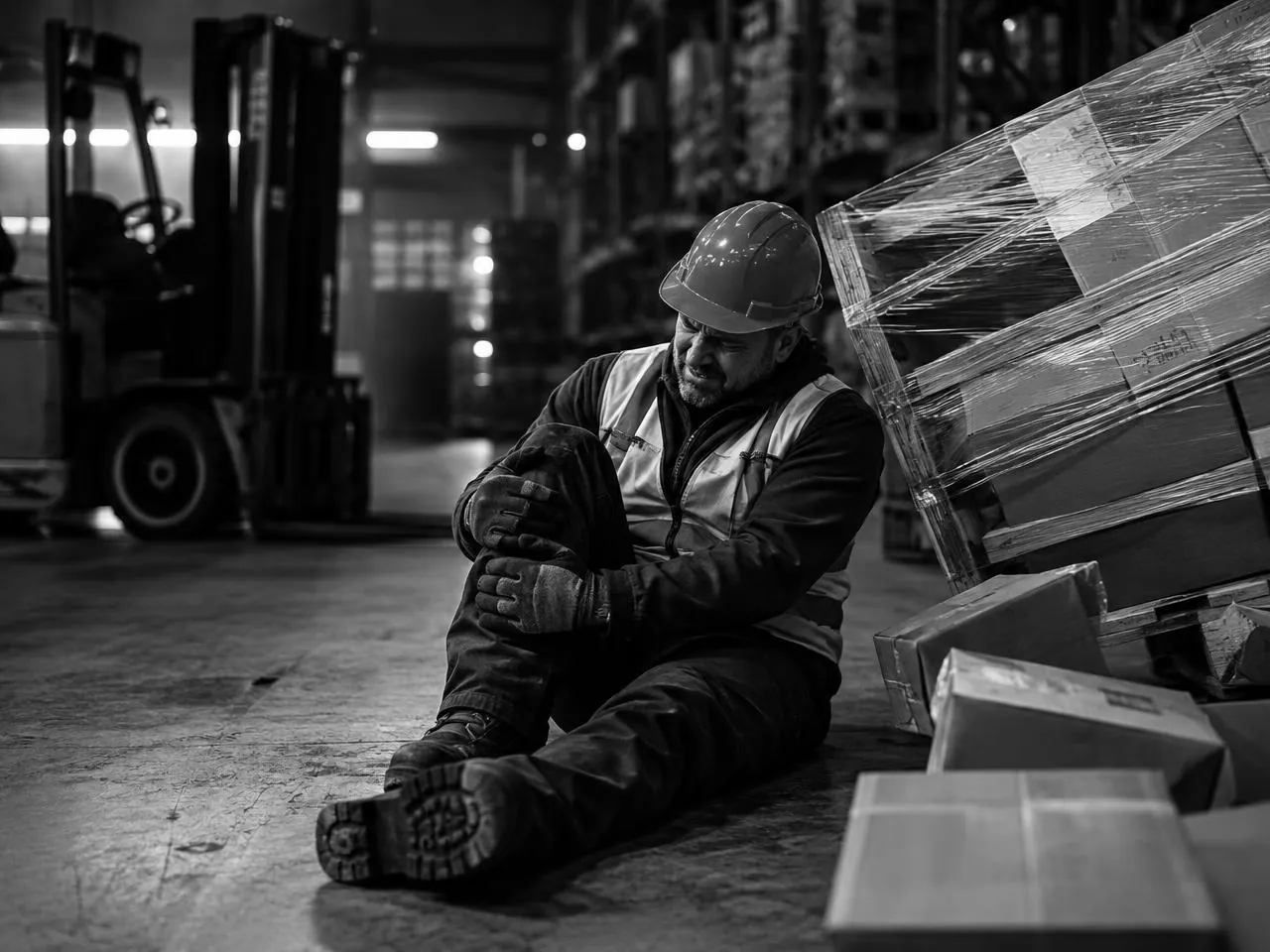
An injured warehouse worker seated beside pallets and a forklift

Delaware workplace injury guidance

Delaware Warehouse Injury Claims

A warehouse injury may involve lifting, racks, powered trucks, loading areas or another company’s operations. Delaware compensation depends on covered employment and the work connection; a separate claim requires supported third-party responsibility. Preserve task and employer records, medical restrictions and incident evidence rather than assuming every warehouse hazard creates the same claim.

Free consultation

What matters now

Separate the injury, the employment and the claim.

An industrial incident can raise benefit, equipment and third-party questions at the same time. The correct path depends on evidence, not the label on an insurance file.

01

Put safety and treatment first

Get appropriate medical help and stay away from energized equipment, unstable structures and hazardous substances. Do not collect evidence by returning to an unsafe work area.

02

Preserve the records you can lawfully keep

Save reports, witness contacts, work assignments, equipment identifiers, medical restrictions and insurer letters. Do not take restricted company records or disturb equipment.

03

Review notice, filing and overlapping claims

Employer reporting and formal filing are different steps. Ask for review of the incident, employment relationships, payment history and any proposed agreement before assuming a deadline or a settlement's effect.

How I help

Start with a free review of what happened.

Call Michael directly at 302-290-4646. He reviews Delaware injury cases and can discuss the evidence needed, potential representation and meeting arrangements. No attorney fee is due unless money is recovered; expenses and engagement terms are addressed in writing.

The task explains the evidence needed

A lifting complaint needs task and symptom history; a struck-by incident needs information about the moving load and operator. Record the actual assignment rather than using a generic description of warehouse work. Medical causation and eligibility remain separate questions. 19 Del. C. § 2304 — compensation and employer remedy · 19 Del. C. § 2322 — medical benefits

Keep schedules, instructions, incident communications and restrictions. If symptoms developed gradually, provide the true chronology rather than inventing one dramatic accident. Do not exaggerate load weights or measurements you did not know. 19 Del. C. § 2304 — compensation and employer remedy · 19 Del. C. § 2322 — medical benefits

Powered trucks and pedestrian routes

Powered industrial truck requirements address matters including operation and training under their terms. Whether the rule applies and was violated requires the equipment and task facts; it is not automatic proof of civil liability. OSHA 29 CFR 1910.178 — powered industrial trucks · 19 Del. C. § 2363 — third-party claims and reimbursement

Identify the operator’s employer, route, load and companies present. A visiting delivery business or equipment service company may warrant investigation, but separate liability depends on legal relationships and evidence of causation. OSHA 29 CFR 1910.178 — powered industrial trucks · 19 Del. C. § 2363 — third-party claims and reimbursement

Restricted return and benefit disputes

Save before-and-after earnings, work-status notes and the complete light-duty offer. Reduced hours caused by restrictions differ from unrelated scheduling changes. Statutory benefit calculations require the evidence and applicable category. 19 Del. C. §§ 2321, 2324–2325 — wage benefits · 19 Del. C. § 2322 — medical benefits · 19 Del. C. § 2361 — filing provisions

Do not assume receiving one check protects all later filing requirements or guarantees continued treatment authorization. Keep notices and payment history and ask for an individual review of the disputed issue. 19 Del. C. §§ 2321, 2324–2325 — wage benefits · 19 Del. C. § 2322 — medical benefits · 19 Del. C. § 2361 — filing provisions

Which claim path needs review?

SituationQuestion to investigateWhat can change it
Covered employee injured at workWorkers’ compensation benefitsEmployment, causation, exclusions and timely procedures
Another company contributedSeparate third-party responsibilityLegal relationship, immunity, fault and reimbursement
Qualifying railroad employmentFederal FELA assessmentCovered carrier, duties, negligence and proper forum

19 Del. C. § 2304 — compensation and employer remedy · 19 Del. C. § 2363 — third-party claims and reimbursement

Sources and further reading

Attorney advertising and general information, not legal or medical advice. Reading this page, contacting the site or using chat does not create an attorney-client relationship. Current law and individual facts control; no result or timetable is guaranteed. Safety standards are not automatic findings of civil liability.

What this warehouse claim may involve

Who may be responsible

Employer, warehouse operator, staffing agencies and outside haulers. Each party’s actual role and a supported legal basis need review; involvement alone does not establish liability.

Warehouse evidence to preserve safely

Care and emergency assistance come first. Keep what you lawfully have; do not enter dangerous areas, confront anyone or alter potential evidence. An attorney can discuss records controlled by others.

  • Dock or aisle location
  • Rack, pallet and powered-truck identifiers
  • Delivery company and operator names
  • Assignments and staffing records
  • Incident reports, restrictions and earnings history
Printable evidence checklists

Compare the applicable claim paths

Compensation and a third-party claim can address different responsibilities. Staffing relationships, loading control and the identity of an outside driver matter. A warehouse injury alone does not show whether rack design, loading, maintenance or an operator’s conduct caused the harm.

Notice and filing decision aid · Delaware injury answers

What happens after you contact Michael

Start with the location, dates, people involved, treatment and the question worrying you most. For a warehouse review, the records above help identify the next investigation steps. Do not upload sensitive medical files to the initial form.

Michael can discuss possible representation, missing evidence, applicable timing and written fee and expense terms. The initial review is free; no attorney fee is due unless there is a recovery. A request or conversation does not itself create representation, stop a deadline or guarantee acceptance or an outcome.

Discuss your warehouse situation

Primary legal sources

A closer look

Clear answers at a difficult time.

An injured warehouse worker seated beside pallets and a forklift

What facts matter after a lifting or falling-load injury?

Describe the actual task, moving object and operator rather than assuming all warehouse injuries need the same proof.

An injured warehouse worker seated beside pallets and a forklift

How should I document gradually developing warehouse symptoms?

Keep the true symptom and work chronology; do not assign an invented single-accident date.

An injured warehouse worker seated beside pallets and a forklift

Do forklift safety standards prove liability automatically?

No. Covered equipment, compliance, responsibility and causation require separate review.

An injured warehouse worker seated beside pallets and a forklift

Can a visiting delivery company be responsible?

Possibly, if legally supported conduct contributed. Identify the visiting business and its role without assuming liability.

An injured warehouse worker seated beside pallets and a forklift

What records matter when I return at reduced pay?

Bring restrictions, light-duty offers and pre/postinjury pay records so injury-related loss can be separated from unrelated scheduling.

An injured warehouse worker seated beside pallets and a forklift

Does one benefit check protect all later deadlines?

No blanket rule applies. Review the statutory filing requirements, payment basis and treatment disputes independently.

Start with a conversation

You do not have to sort this out alone. One call is all it takes to get the answers you need.

Request a free consultation

Tell me what happened.

Send your information to request a free consultation with Michael. Prefer to talk now? Call 302-290-4646.

Submitting this form does not create an attorney-client relationship. Please do not include confidential details until we have spoken.