Published
Responsibility can reach past the driver
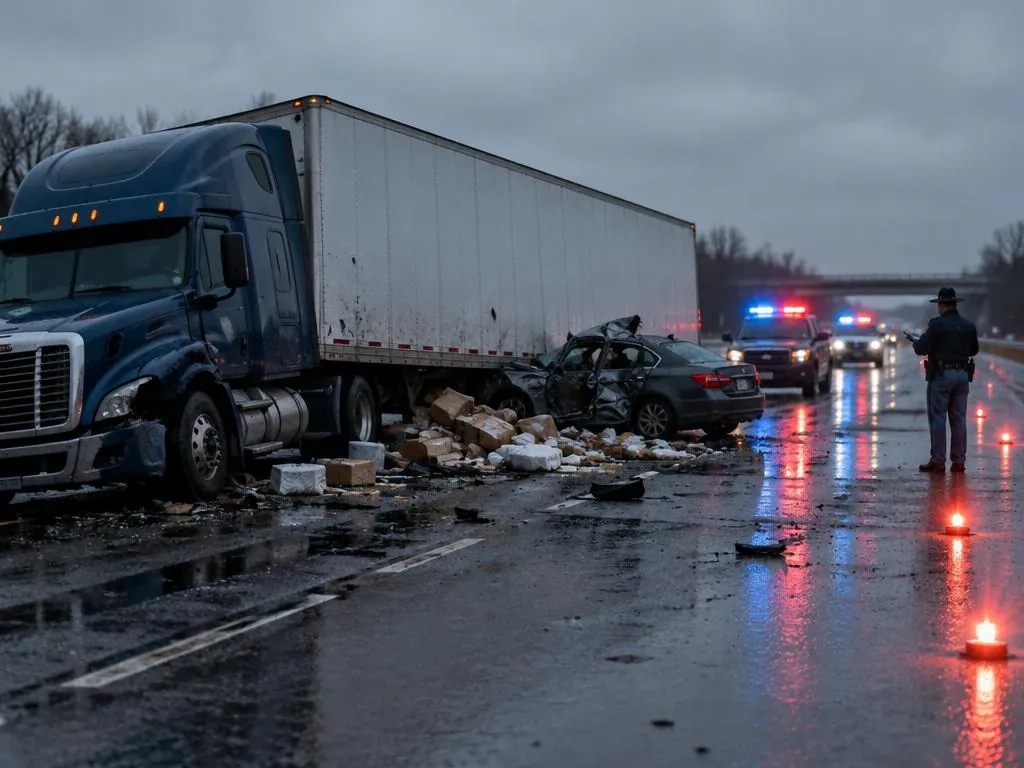
A collision involving a tractor-trailer on I-95, I-495, Route 1 or another Delaware roadway may involve the driver, the motor carrier that dispatched or employed them, and companies that loaded, maintained or built the vehicle. Liability follows the evidence connecting each party's conduct to the crash, not the number of companies named.
Federal law gives safety regulators authority to set minimum standards for commercial carriers and drivers under 49 U.S.C. § 31502. A documented violation can support a negligence argument, but it does not by itself prove the violation caused your injuries. That link still has to be established from the records.
49 U.S.C. § 31502 — federal motor carrier safety standards · 49 C.F.R. § 395.3 — hours of service · 49 C.F.R. § 396.3 — inspection, repair and maintenance records · 21 Del. C. § 2118 — Delaware PIP · 18 Del. C. § 3902 — uninsured and underinsured motorist coverage · 10 Del. C. § 8119 — personal-injury limitation
Hours-of-service and duty-status records
49 C.F.R. § 395.3 limits how long a property-carrying driver may drive and remain on duty, and requires records of duty status. Electronic logging device data, paper logs, supporting documents such as toll, fuel and delivery receipts, and dispatch messages can show whether fatigue or schedule pressure played a part.
These records are often overwritten or purged on a carrier's own schedule. A preservation request that identifies the vehicle, the date and the specific data types is how a claim asks for them before the retention window closes.
49 U.S.C. § 31502 — federal motor carrier safety standards · 49 C.F.R. § 395.3 — hours of service · 49 C.F.R. § 396.3 — inspection, repair and maintenance records · 21 Del. C. § 2118 — Delaware PIP · 18 Del. C. § 3902 — uninsured and underinsured motorist coverage · 10 Del. C. § 8119 — personal-injury limitation
Inspection, repair and cargo records
49 C.F.R. § 396.3 requires motor carriers to systematically inspect, repair and maintain commercial vehicles and to keep records of that work. Brake condition, tires, lighting, coupling devices and prior out-of-service defects can each become a reconstruction question after a crash.
Where shifting or falling load is part of the theory, the shipping papers, load manifest, securement photographs and the loading company's procedures identify who packed the trailer and how. Telematics and event data from the tractor may show speed, braking and stability control activity in the seconds before impact.
49 U.S.C. § 31502 — federal motor carrier safety standards · 49 C.F.R. § 395.3 — hours of service · 49 C.F.R. § 396.3 — inspection, repair and maintenance records · 21 Del. C. § 2118 — Delaware PIP · 18 Del. C. § 3902 — uninsured and underinsured motorist coverage · 10 Del. C. § 8119 — personal-injury limitation
Insurance, PIP and the Delaware clock
Delaware personal injury protection under 21 Del. C. § 2118 may address eligible medical expenses and earnings loss without first proving fault, while a negligence claim against the carrier is a separate matter. When a truck's limits cannot cover the supported losses, uninsured and underinsured motorist coverage under 18 Del. C. § 3902 may warrant review.
Delaware's general two-year personal-injury limitation in 10 Del. C. § 8119 is not the only deadline in play. Multiple policies, self-insured carriers and early settlement offers that resolve more than the payment being made all require review before you sign anything.
49 U.S.C. § 31502 — federal motor carrier safety standards · 49 C.F.R. § 395.3 — hours of service · 49 C.F.R. § 396.3 — inspection, repair and maintenance records · 21 Del. C. § 2118 — Delaware PIP · 18 Del. C. § 3902 — uninsured and underinsured motorist coverage · 10 Del. C. § 8119 — personal-injury limitation
Bring what you have
Start with the crash date and location, the trucking company name or USDOT number if you have it, photographs, your treatment records and any insurer correspondence. You do not need the carrier's file to ask a question.
Michael can review the collision, identify which records should be requested and explain which parties and policies may be involved. The evaluation is free and confidential, and no result or timetable is promised.
49 U.S.C. § 31502 — federal motor carrier safety standards · 49 C.F.R. § 395.3 — hours of service · 49 C.F.R. § 396.3 — inspection, repair and maintenance records · 21 Del. C. § 2118 — Delaware PIP · 18 Del. C. § 3902 — uninsured and underinsured motorist coverage · 10 Del. C. § 8119 — personal-injury limitation
Sources & further reading
- 49 U.S.C. § 31502 — federal motor carrier safety standards
- 49 C.F.R. § 395.3 — hours of service
- 49 C.F.R. § 396.3 — inspection, repair and maintenance records
- 21 Del. C. § 2118 — Delaware PIP
- 18 Del. C. § 3902 — uninsured and underinsured motorist coverage
- 10 Del. C. § 8119 — personal-injury limitation
This article provides general information, not legal advice. Laws and procedures can change; deadlines and available claims depend on individual circumstances. No result is guaranteed.